About The Triangle Transportation Choices Program
Triangle Transportation Choices, a Transportation Demand Management (TDM) program, is a marketing and outreach effort to promote alternative transportation modes within a seven-county region of North Carolina 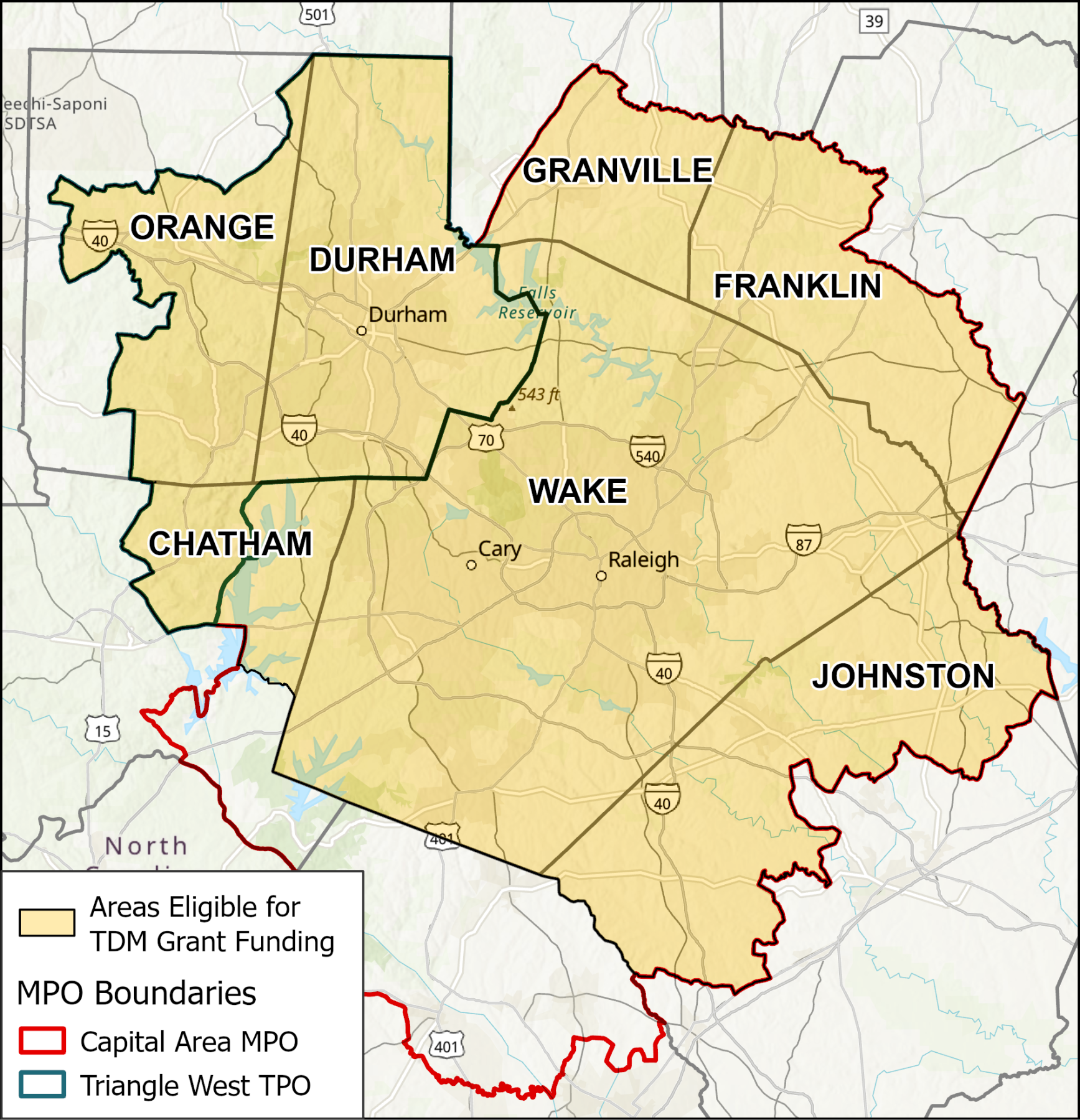 including the Triangle. This seven-county region includes all of Wake and Durham counties and specific areas of five other counties - Orange, Chatham, Franklin, Johnston, and Granville. The exact geographic boundaries for the program can be found in the image to the left. An interactive online map of the Grant Funding Eligibility Area is available here.
The Triangle Transportation Choices program was established in 2007 with the primary goal of reducing the annual growth in Vehicle Miles Traveled (VMT) by 25 percent. Since its inception, the program has exceeded this goal every single year. Historically, the initiative has operated as an annual grant program supporting municipalities, universities, and colleges throughout the region in implementing TDM strategies.
Through the program, CPRC seeks to reduce reliance on single-occupancy vehicles, improve community health, lower transportation costs for residents, and enhance regional economic resilience. There are numerous well-documented benefits associated with the use of alternative transportation modes promoted through TDM strategies. Options such as transit, carpooling, vanpooling, biking, walking, and telecommuting make more efficient use of existing transportation infrastructure, reduce traffic congestion, and improve air quality. Active transportation modes, particularly biking and walking, have also been linked to improved physical and mental health outcomes.
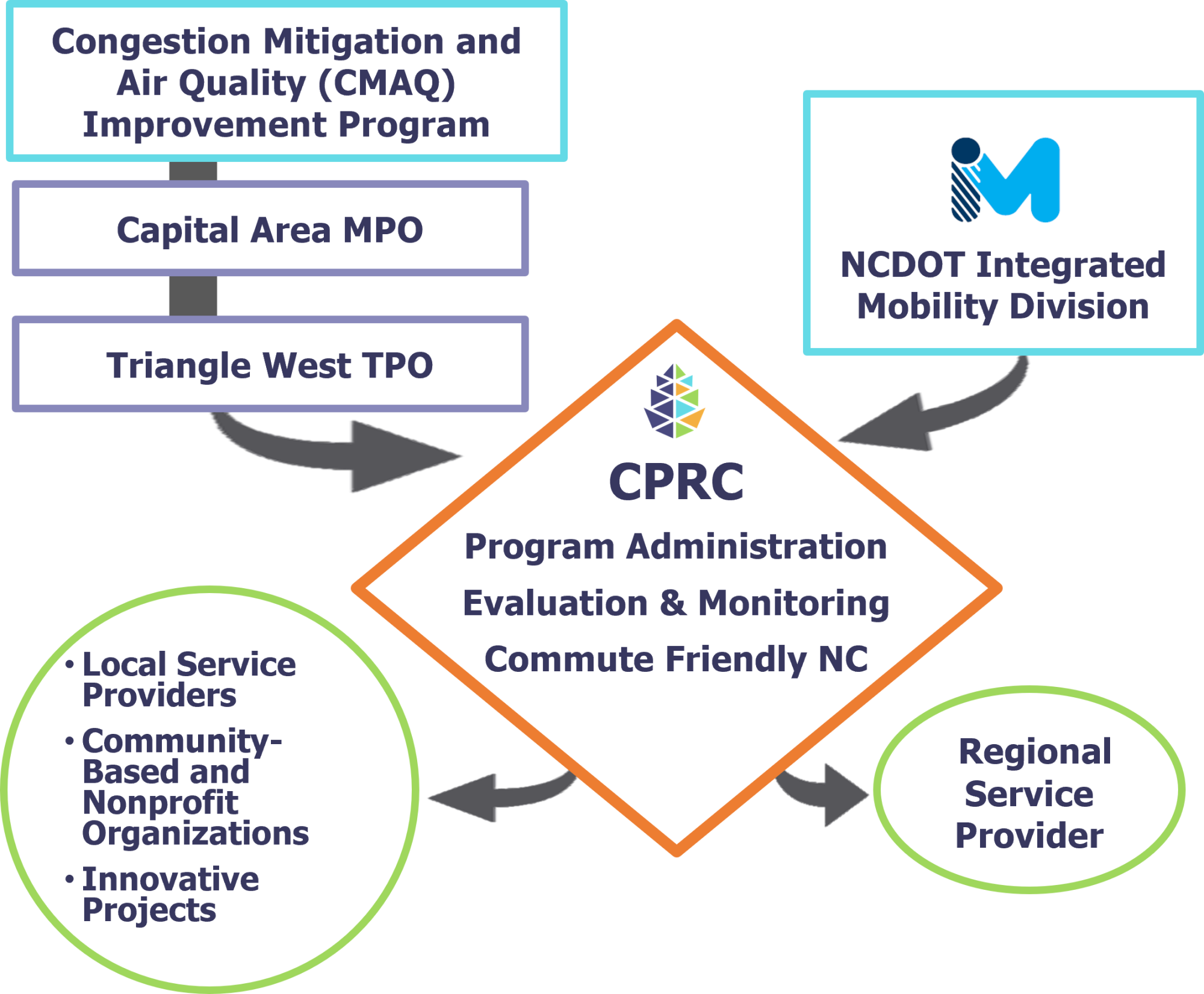
The Triangle Transportation Choices program receives funding from 3 different organizations: Capital Area Metropolitan Planning Organization (CAMPO), Triangle West Transportation Planning Organization (TWTPO) and North Carolina Department of Transportation- Integrated Mobility Division (NCDOT-IMD). A representative from each of these three funding organizations serves as a voting member in the program’s Oversight Committee (OC) (Graphic below). The OC has two additional members in advisory roles- one each from the 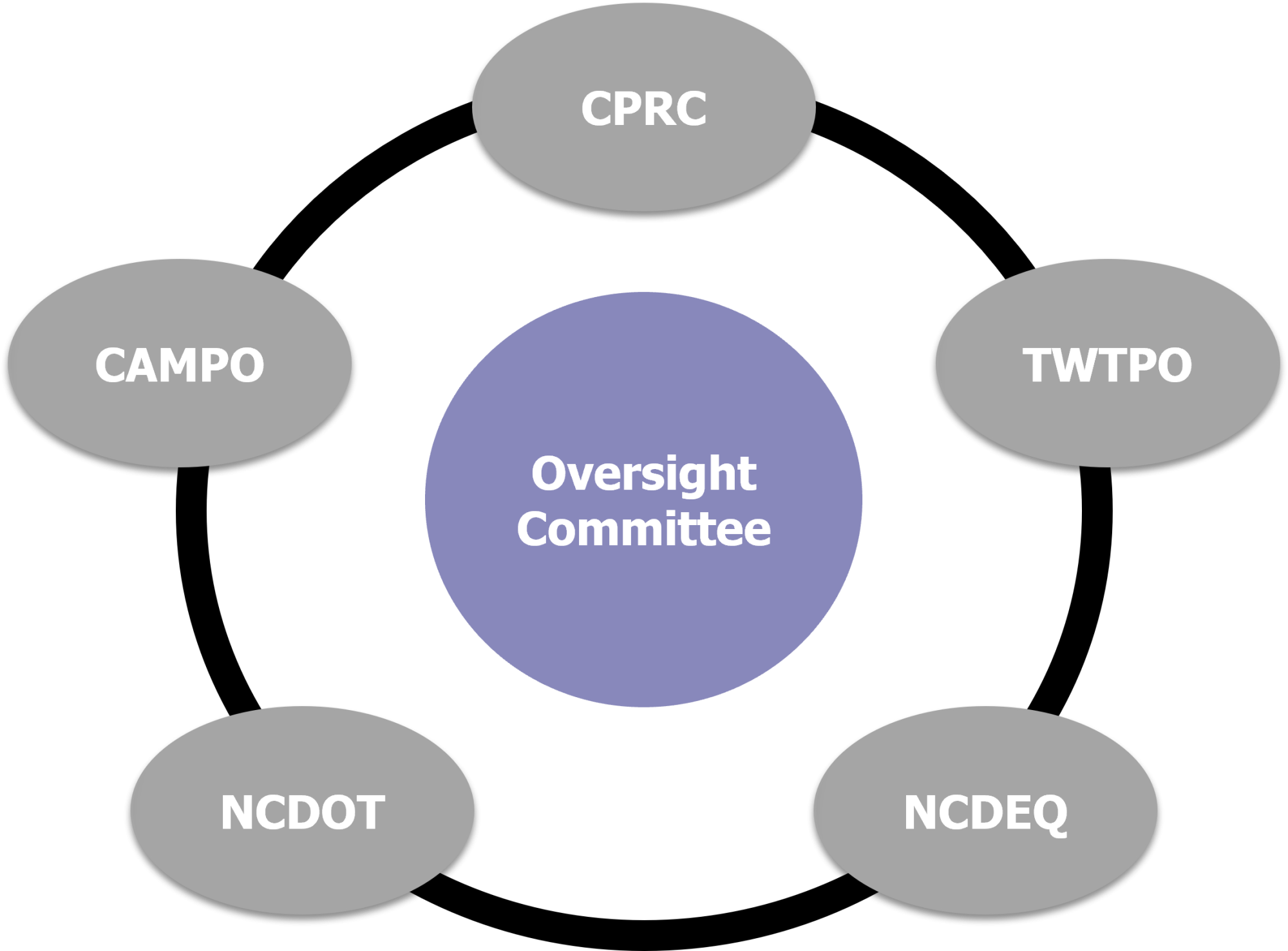 North North Carolina Department of Environmental Quality (NCDEQ) and Central Pines Regional Council (CPRC). The OC provides overall policy direction and guidance to the grant program, reviews all the grant applications, and makes the final decisions regarding grant awards. The graphic on right hand side illustrates the funding and administrative structure of the program.
The program has continued to evolve over the years to better meet the needs of the region and its partners. In FY23, the program launched a pilot initiative that provided funding to six community-based and nonprofit organizations for the first time in the program’s history, expanding access to funding beyond traditional municipal and higher education partners. In FY25–26, the program introduced its first-ever two-year funding cycle to reduce the administrative burden associated with annual applications while providing grantees with greater stability, continuity, and certainty in planning and implementing their TDM initiatives. For FY27, the program has awarded approximately $2.1 million to 18 agencies to support TDM activities and grant administration. Award packages were distributed to recipients in May 2026.
CPRC Is An Accredited TDM Organization
Central Pines Regional Council has been recognized as an Accredited TDM Organization by the Association for Commuter Transp
These high-performing organizations have proven they possess the governance, structure, and integration with the broader field required to deliver effective programs and services. They are the first to achieve accreditation, which will last for three years. At that time, they must provide documentation of their continued excellence and improvement to renew their status.
For more information on ACT accreditation, see here(opens in a new tab).
The following organizations have been awarded funding for FY27riangle Transportation Choice grant program:


| City of Raleigh | Commute Friendly NC

| GoTriangle | Town of Chapel Hill


NC Central University | NC State University


UNC Chapel Hill | Wake Tech CC


Arise Collective | Bike Durham | Black Girls Do Bike

El Centro Hispano | Oaks and Spokes

Habitat for Humanity- Orange County | Southeast Raleigh Promise
Every year, the Triangle Transportation Choices program releases an Annual Impact Report (PDF, 16.04 MB) that showcases the many positive effects the program has on the region and its residents. These impacts range from emission reductions to reductions in congestion to improved physical health.
Some highlights from fiscal year 2025 include 5 million avoided vehicle trips and $30 million in savings due to societal benefits. With the program only costing $2.1 million in FY25, the return on investment was over 14 times the cost!


For more information about the program, please read our latest Annual Impact Report's Executive Summary (PDF, 423.73 KB), and Full Methodology (PDF, 189.12 KB).
Meet the team that works on this program!
Shuchi Gupta Principal Planner | Laura Gomez Rodriguez Planner II | Joining Soon Planner I | |
 | Photo Coming Soon | ||
| Grant Manager | Program Analyst | CFNC Program Coordinator | |
If you have questions about the program or think your organization would be a good fit for it, please reach out to Shuchi Gupta at sgupta@centralpinesnc.gov.