
Promoting resilient and equitable development practices that improve people's quality of life.
We take a comprehensive approach to ensure robust and resilient economic growth in our region and incorporate factors that contribute to economic activity and workforce productivity, such as safe and affordable housing, sustainable land use practices, and strategic asset-building.
As the designated Economic Development District for the region, CPRC serves as a direct connection between local funding seekers and the U.S Economic Development Administration and oversees the implementation of the region's Comprehensive Economic Development Strategy (CEDS) to guide and monitor development efforts.
Areas of Focus
We support regional projects and build capacity for local economic development activities in communities of all sizes, from large urban areas to small suburban and rural areas, by focusing on:
- Business Retention, Expansion & Innovation
- Robust Infrastructure
- Workforce Development
- Connected & Vibrant Places
- Economic Resiliency
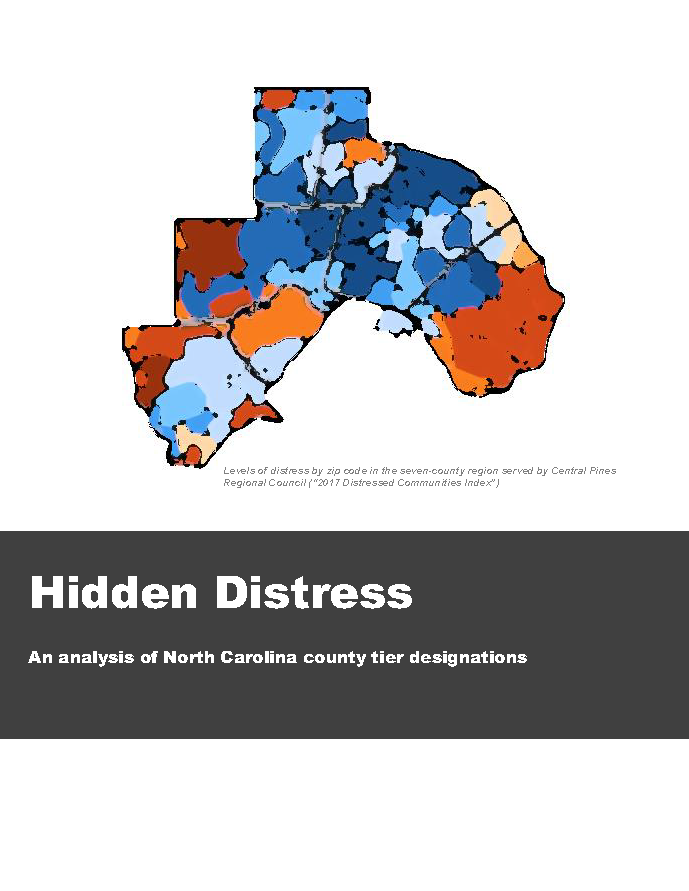
Our region continues to grapple with fast population growth and strong economic development, but the benefits and challenges of its growth are not felt evenly across the region.
With one of the state’s most populous counties, (Wake, with over a million residents), and almost thirty municipalities with fewer than 10,000 residents, the region has a geographic and demographic diversity, spanning urban, suburban, and rural contexts. This diversity can be challenging and economic data hides many of our region's challenges.
Within the NC Department of Commerce’s County Distress Rankings(opens in a new tab) (Tier System), small low-wealth communities that are located in wealthier counties face barriers to accessing many state funding programs that are tied to the tier system rankings. With the exception of Lee County, which is Tier 2, all of the region's other counties are categorized as Tier 3 (least distressed).
Regional Digital Opportunity
Digital opportunity is a cornerstone of equitable access to opportunity in today’s economy, education systems, and civic life. Across a seven-county region, one of the core goals of Central Pines Regional Council is to support our member counties in expanding reliable high-speed internet access, increasing affordability of service and devices, and strengthening the digital skills needed to fully participate in an increasingly connected world.
For Central Pines, this work involves coordinating across local governments to better understand regional disparities, align strategies for broadband expansion and adoption, and support member communities as they work to bridge digital divides. By advancing digital opportunity at a regional scale, Central Pines helps its members strengthen their own efforts to expand access to employment, education, healthcare, and essential government services, regardless of where residents live in the region.
Triangle Region Digital Opportunity Hub
County-Based Resources
Listed below are County-based digital opportunity resources.
Chatham County (PDF, 488.88 KB)
Durham County (PDF, 219.83 KB)
Johnston County (PDF, 192.29 KB)
Orange County (PDF, 162.04 KB)
Hayti CDC FAYETTEVILLE STREET CORRIDOR PROPERTY RESILIENCE INITIATIVES AND EVENTS
Central Pines Regional Council is partnering with Hayti Promise Community Development Corporation and the City of Durham to connect residents in the Fayetteville Street Corridor with resources to improve their homes, lower energy costs, and protect their property for the future.Programs include green energy retrofits, residential solar, property legal services, and property tax navigation. These initiatives are supported using American Rescue Plan Act (ARPA) funding.
UPCOMING Hayti CDC COMMUNITY EVENT: WILLS & ESTATE PLANNING
Join Hayti Promise CDC, Land Loss Prevention Project, Central Pines Regional Council, and the City of Durham for a free Wills & Estate Planning community session.
Saturday, September 19, 2026 | 10:00 - 11:30 a.m.
W.G. Pearson Center Training Room 103 | 600 E. Umstead Street, Durham, NC 27701
Land Loss Prevention Project will walk participants through the basics of wills, what happens when someone passes away without a will, powers of attorney, health care powers of attorney, and other important estate planning considerations. You do not need to have an estate plan or know where to begin. This session is an opportunity to learn more, ask questions, and better understand the options available to you and your family.
The event is free, but registration is required. Free parking is available at W.G. Pearson Center, and light refreshments will be provided.
[REGISTER FOR THE SEPTEMBER 19 EVENT HERE!]
https://docs.google.com/forms/d/e/1FAIpQLSeT60t7vjodbwQweluMhKAcR5WhBFH…
The registration form can also be used to let us know if you are interested in learning more about Property Legal Services, Green Energy Retrofits, Residential Solar Energy, or Property Tax Relief. Eligible residents and property owners within the Fayetteville Street Corridor can select the initiatives they are interested in and provide their preferred contact method so a member of the project team can follow up.
GREEN ENERGY RETROFITS
Eligible homes may receive up to $15,000 in energy-efficiency improvements installed at no cost. These improvements can help lower utility bills, improve comfort, make homes safer, and help homeowners remain in their homes longer.
Your home may be eligible if you:
- Own and occupy a home within the Fayetteville Street Corridor project area
- Have a household income at or below 80% of the Area Median Income (AMI)
- Are current on your Durham County property taxes
- Do not own any other residential property
- Can get written approval from any co-owners
Energy retrofits may include:
- Home energy assessment and energy audit
- Insulation, air sealing, and related weatherization measures
- Heating, cooling, and water heater improvements
- Electrical, safety, and other minor repairs
- Energy-efficient lighting, appliances, and fixtures
RESIDENTIAL SOLAR ENERGY
Eligible homeowners may receive a rooftop solar energy system installation at no cost. Solar can help lower energy bills, increase energy independence, and improve a home's resilience.
In addition to the eligibility requirements above, the home must have a roof and property location suitable for solar installation.
Installation may include:
- Roof condition assessment
- 4.6 kW rooftop solar energy system
- Backup battery storage equipment
- Required permits, inspections, and utility connections
- Manufacturer and workmanship warranties
PROPERTY LEGAL SERVICES
Eligible participants may receive free property-specific legal counseling to help protect their property and plan for the future.
Services may address:
- Estate planning and wills
- Heirs' property
- Ownership and title issues
- Other property-related legal needs
Assistance is based on eligibility, level of need, and the nature of the legal question. Services may be provided individually or through community education events, including wills clinics and lunch-and-learns. All direct legal services are confidential.
Legal services are provided by the Land Loss Prevention Project (LLPP), a Durham-based nonprofit that works to protect vulnerable landowners from land loss through legal representation, technical assistance, and community education.
PROPERTY TAX NAVIGATION
Hayti Promise CDC is helping homeowners and property owners in the Fayetteville Street Corridor understand and access property tax relief programs they may qualify for. Staff can help identify potential programs, explain eligibility and application requirements, and provide guidance through the application process.
Programs include:
- Elderly/Disabled Homestead Exemption
- Circuit Breaker Elderly/Disabled Deferment
- Disabled Veteran Property Tax Exclusion
- Durham County DSS Low Income Homeowner Relief
- Builder Property Tax Exemption
LEARN MORE & GET CONNECTED
Interested in one of the Fayetteville Street Corridor Property Resilience Initiatives? Complete our short interest form to tell us which resources you would like to learn more about. Funding is limited, deadlines apply, and eligibility varies by program.
https://docs.google.com/forms/d/e/1FAIpQLSeT60t7vjodbwQweluMhKAcR5WhBFH…
Funding is limited, deadlines apply, and eligibility varies by program.
Contact Hayti Promise CDC to learn more!
Hayti Promise CDC
resources@haytipromisecdc.org
(919) 283-1740